
5 Winter Destinations for a Bucket List Winter Trip
October 2026
Please Note: This post may contain affiliate links, meaning if you book through them I may earn a small commission, at no extra cost to you. I only recommend places, activities, accommodations, and products that I believe may be useful or would personally use.
Snow covered landscapes, cosy cafés, winter activities and festive Christmas markets; there is something special about travelling in winter, and some destinations feel a little more magical during the winter season, and are worth adding to your winter travel bucket list.
If you're looking for inspiration for your next winter destination and trip, there are so many incredible places to consider, depending on the kind of winter escape you're dreaming of.
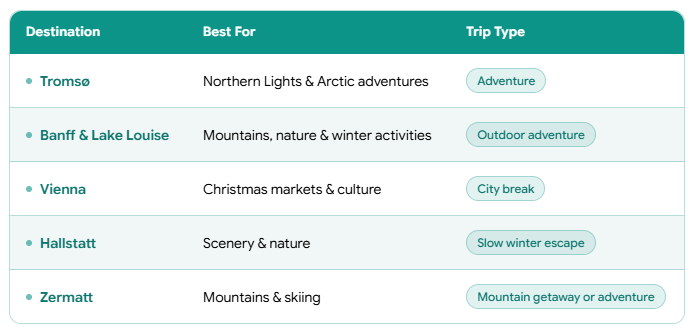
This post covers five winter destinations, each beautiful and offering a unique winter escape. From Arctic adventures and chasing the Northern Lights in Norway, to exploring the snow covered Canadian Rockies, wandering through Vienna's festive streets on a city break, admiring the fairytale lakeside scenery in the village of Hallstatt, and taking in the spectacular Alpine views in Zermatt; these are five of the best winter destinations to consider for your next winter trip.
Contents and Navigation
Tromsø, Norway
If an Arctic adventure, wildlife sightings and the Northern Lights are items on your travel bucket list, Tromsø could be the perfect destination to tick all 3 in the one trip.
Located in Northern Norway, above the Arctic Circle, Tromsø is surrounded by snow covered mountains, beautiful fjords and Arctic landscapes. During winter, with a bit of luck and the right weather conditions, Tromsø is ideally located for seeing the Aurora Borealis dancing across the night sky, plus the opportunity to see orcas and humpback whales in the wild, and reindeer in the snow. All in all a winter wonderland, the city is a fantastic base for exploring the region and participating in winter activities.
Tromsø truly is a bucket list winter destination.
Why Visit Tromsø in Winter?
The Northern Lights are one of the biggest reasons to visit in winter, but there is much more to Tromsø than chasing the Aurora. That being said, winter in Tromsø is a great time for Northern Lights viewing as the nights are long and this together with Tromsø’s location beneath the Auroral oval make for prime Northern Lights sightings, provided you can find clear skies!
I visited Tromsø in December, during Polar Night, when the sun doesn’t rise above the horizon, which was in itself, special to experience: I have a dedicated post on what it is like Visiting Tromsø During Polar Night.
Winter in Tromsø is also a great time for sightseeing around the region if you want snowy Arctic landscapes. It is an ideal time for many activities such as: whale watching in the fjords (whales are generally found in the fjords in northern Norway from late October to late January), joining a Sami cultural and reindeer experience, snowmobiling, snowshoeing, and fjord excursions. You can also spend time exploring Tromsø city itself, escaping the Arctic cold to go indoors and enjoy the local restaurants, cafés, museums and shops.
One of my favourite things about Tromsø was that there are so many experiences to enjoy during the day, and you never quite know when the Northern Lights might make an appearance in the evening/night. I was lucky enough to see the Northern Lights on three out of four nights during my trip, including one evening when I saw them from Tromsø city center, and another sighting on the journey back to Tromsø after a whale watching cruise, when the Aurora appeared above the Arctic waters.
Tromsø is a magical place, especially in winter, but it is also important to recognise that since it is located above the Arctic Circle the weather is unpredictable and can be extreme. Snow storms and blizzards can occur, during which it can unsafe to be outside and therefore plans and activities may be postponed or cancelled. Given this, if you are planning a trip, it's worth having a flexible mindset. Have a backup plan for days when outdoor activities might be cancelled (museums, indoor attractions, or simply exploring the city center are good fallback options).
When is the Best Time to Visit Tromsø?
For a classic winter trip, I'd consider November to March. This is a great time to experience snowy Arctic landscapes, winter activities and chances to see the Northern Lights / Aurora Borealis. Winter brings short days and long nights, while the Polar Night (end of November until mid-January) period offers a distinctive twilight glow for a few hours a day rather than complete darkness 24 hours a day.
If seeing the Northern Lights is your main priority, the wider Aurora season generally runs from late August to early April, although seeing the lights is never guaranteed as they are a natural phenomenon and seeing them depends on darkness, cloud cover and Aurora activity. I have a separate post dedicated to the Northern Lights In Tromsø: When, Where and How to See The Aurora.
If seeing orcas and humpback whales in the wild is on your bucket list, the whales are generally found in the fjords in northern Norway from late October to late January.
December and early to mid January offer the distinctive atmosphere of the Polar Night, while February and March bring increasingly longer days for exploring the surrounding landscapes but nights are still long and dark for potential Northern Lights viewing.
Visiting in September, October or April can give you a different balance of daylight and winter conditions, although you may not get the snowy Arctic landscape you associate with this region of the world, and activity availability can vary during these months.
How long do I need to stay in Tromsø?
I would suggest staying four to five nights, to give you time to enjoy several activities and excursions, while also allowing time to explore the city center and relax in the saunas or cosy cafes.
If the Northern Lights are high on your bucket list, staying for several nights also gives you more opportunities to see them if the weather doesn't cooperate every evening.
Where should I stay in Tromsø?
Staying in central Tromsø is a convenient option, particularly if you want to explore the city on foot, visit restaurants and cafés, and join organised tours (most of which have starting points in the city center).
During my trip, I stayed in The Dock 69 39 by Scandic which was newly opened at the time (December 2025) and it was a lovely hotel in a great city center location. It had the added bonus of a rooftop area, from which I watched the Northern Lights one evening.
If you are dreaming of a quieter stay surrounded by Arctic scenery, a cabin outside the city could be worth considering, like Aera Glass Cabins, where you may well be able to watch the northern lights in the sky as you lie in bed.
Best Winter Activity in Tromsø
A Whale Watching Cruise, and a Northern Lights Chase
I couldn’t write this post and only list one winter activity for Tromsø. My personal favourite activity was the whale watching cruise, it was simply magical seeing majestic orca and humpback whales in their natural habitat in the fjords. But, I feel like no Tromsø winter trip activity list is complete without mentioning the Northern Lights. Of course, seeing the Aurora is never guaranteed, but joining a dedicated chase gives you the opportunity to travel away from the city in search of clearer skies. It's an experience I'd recommend considering if seeing the Northern Lights is one of the main reasons for your trip.
Find your ideal hotel in Tromsø:
Book your activities and tours in Tromsø:
Who is Tromsø best for?
Travelers looking for an adventurous winter getaway, Arctic wildlife experiences and the chance to see the Northern Lights.
Read more: Tromsø Winter Travel Guide | Northern Lights in Tromsø: When, Where & How to See the Aurora | The 3 Best Things to do in Tromsø
Banff & Lake Louise, Canada
For an ultimate dreamy winter wonderland trip, in a destination that looks like a living postcard, Banff in the Canadian Rockies is a must visit destination to add to your bucket list.
Banff National Park is famous for its dramatic mountain scenery, turquoise lakes and outdoor adventures. While the lakes are a major attraction during summer, winter transforms the area into a landscape of snowy forests, frozen lakes and waterfalls, and snow covered peaks.
If your idea of a perfect winter getaway involves spending your days outdoors and returning to a cosy mountain town, or lakeside resort, in the evening, Banff or Lake Louise could be the perfect place for your next winter trip.
Why Visit Banff in Winter?
In winter, Banff becomes a dreamy winter wonderland, covered in snow and ice. It is an excellent destination for anyone who loves the outdoors, whether that be going skiing or snowboarding, or simply exploring and appreciating the nature and scenery.
The magic of Banff begins with the journey: driving along the Trans-Canada highway from Calgary to Banff, the views of the rocky mountains in front of you have to be seen to be truly appreciated, no photo or video does this view justice. Then you arrive in the town of Banff, a lively mountain resort town with holiday lights and plenty of restaurants and shops. The highlight of visiting Banff town has to be the view walking down Banff Avenue (the main street), with Cascade Mountain towering above the town and framing the street perfectly. This view doesn’t get old no matter how many times you walk the street on your visit, and the light reflecting off the mountain at sunrise can cause a soft glow over the snowy peak that is simply spectacular.
Skiing and snowboarding are hugely popular activities here, and walking around Banff town you will see people in their ski gear with their skis or boards waiting on buses to the resorts. There are 3 main ski resorts in Banff National Park itself, known as the SkiBig3, these are: Banff Sunshine, Lake Louise Ski Resort, and Mt. Norquay.
However, you can also enjoy a winter visit without skiing or snowboarding, with plenty of sightseeing and other activities on offer including:
Visit Lake Louise;
Go ice skating (either in one of the rinks in Banff, or on Lake Louise itself when conditions allow);
Take Banff Gondola to the top of Sulphur Mountain, stroll the boardwalk to Sanson's Peak and Sulphur Mountain, and admire views of Banff National Park's frozen lakes and steep snow covered peaks. There is also an educational center and a restaurant ‘Sky Bistro’ at the top, where you can enjoy some food or drinks while taking in the views (reservations are recommended);
Soak in Banff Upper Hot Springs, experiencing the natural heated geothermal waters, while simultaneously feeling the cool mountain air on your face. The contrast of the two temperatures is an experience, but an enjoyable one;
Visit Bow Falls;
If you want a different view of the Canadian Rockies, from above, you can book a scenic helicopter tour, or a scenic helicopter flight with a stop off for a guided hike.
Last but by no means least, simply enjoy the views of the snow frosted Canadian Rockies!
After a day outside, Banff town has restaurants, cafés and accommodation where you can warm up and unwind. It's a destination that combines outdoor adventure with the comforts of a mountain town.
If you are visiting in November or December, you may also catch the Banff Christmas Market (operating on Thursday through Sunday, between 19th November and 13th December in 2026).
When is the Best Time to Visit Banff?
Winter season in Banff and Lake Louise generally runs from November to March, with some winter activities, including the ski and snowboarding season extending until late May.
I would consider December to March for a classic snowy winter trip. January and February are particularly appealing for skiing, snowboarding and enjoying the winter landscape, although temperatures can be very cold.
If you're hoping to skate on a frozen lake or enjoy a specific seasonal activity, check local conditions before travelling, as these depend on weather and safety assessments. Fairmont Springs ice skating rink on Lake Louise only typically opens in [late December]. Note: skiing on the iconic frozen Lake Louise, crisp air
December to February is a great time to visit Banff for a classic Canadian winter experience, with snow-covered mountain scenery, skiing, snowshoeing, ice skating and other seasonal activities. January and February are particularly good choices for reliable mid-winter conditions, while December adds a festive atmosphere. Keep in mind that snow levels and weather can affect certain activities, so check local conditions before travelling.
How Long to Stay in Banff?
I'd suggest four to seven nights if you're travelling specifically for a winter holiday.
Four nights could give you a taste of Banff and some of its most popular winter activities. A week would allow you to explore more of the surrounding area, spend time in Lake Louise and fit in a mixture of outdoor adventures and slower days.
If skiing is the main reason for your trip, you may want to stay longer so you can enjoy several days on the slopes without rushing.
Where to Stay in Banff?
For a first visit, I'd look at staying in Banff town. It offers a convenient base for restaurants, shops and tour departures, with transport options for getting around the wider area.
Lake Louise is another option if you'd prefer to stay closer to the scenery and winter activities there. Accommodation choices are more limited, so it's worth comparing prices and transport arrangements before deciding.
If you're travelling on a tighter budget, you could also look at Canmore, which is another popular base for exploring the Canadian Rockies. Just factor in the extra travel time when planning your activities.
Best Winter Activity in Banff
Ice skating on Lake Louise.
If conditions permit, skating on a frozen lake with the Canadian Rockies rising around you sounds like the kind of winter experience that belongs on a bucket list.
Even if skating isn't your thing, visiting Lake Louise in winter to admire the surrounding scenery is well worth considering.
Who is Banff best for?
Outdoor enthusiasts, mountain lovers, skiers and anyone dreaming of a snowy Canadian adventure.
Vienna, Austria
Winter doesn't always have to mean mountains, snow and outdoor adventure. Sometimes, a festive European city break is exactly what you're looking for.
Vienna is one of the destinations I'd consider for a winter trip, particularly if visiting Christmas markets is on your bucket list.
With its grand architecture, historic palaces, traditional coffee houses and festive decorations, Vienna offers a different kind of winter magic.
Why Visit Vienna in Winter?
For many visitors, the main attraction is Vienna's Christmas markets.
From early to mid-November, the city's squares begin to fill with festive stalls selling seasonal treats, handmade gifts and decorations. Christmas lights illuminate the streets, and the markets provide plenty of opportunities to try local food and warming drinks.
Rathausplatz is home to one of Vienna's best-known Christmas markets, while other markets can be found around Schönbrunn Palace, Belvedere Palace and in the historic city centre. Opening dates vary, so check the schedule for your travel dates if the markets are the main reason for your visit.
Beyond the Christmas markets, Vienna is a wonderful city to explore in winter. You could spend the day visiting museums and palaces, admire the city's architecture or take a break in a traditional Viennese coffee house.
And if the weather is cold or wet, there are plenty of indoor attractions to enjoy.
When is the Best Time to Visit Vienna?
Mid-November to December is my pick if you want to experience Vienna at its most festive.
The Christmas markets usually begin opening in early to mid-November and continue through the weeks leading up to Christmas, although individual closing dates vary.
If you're more interested in sightseeing, museums and the city's café culture than Christmas markets, January and February can also work well for a winter city break.
How Long to Stay in Vienna?
I'd recommend three to four nights.
This gives you enough time to explore the main sights, visit several Christmas markets if you're travelling during the festive season, and enjoy the city without rushing from one attraction to another.
If you're particularly interested in art, museums, palaces or classical music, you could easily stay longer.
Where to Stay in Vienna?
For a first visit, I'd look for accommodation in or close to the Innere Stadt, Vienna's historic first district. This puts you within easy reach of many of the main sights and makes exploring the city on foot convenient.
You could also consider nearby central districts with good public transport links if you'd prefer more accommodation choices or a different atmosphere.
If you're visiting for the Christmas markets, check the location of the markets you most want to see before booking. Vienna has an excellent public transport network, so you don't necessarily need to stay right beside the main market to enjoy the festivities.
Best Winter Activity in Vienna
Exploring Vienna's Christmas markets.
I'd set aside an evening to wander around the festive stalls, sample seasonal food and enjoy the illuminated squares. You could also visit more than one market during your stay, as each has its own atmosphere.
Who is Vienna Best For?
Culture lovers, foodies and travellers looking for a festive European city break.
Hallstatt, Austria
If you've ever seen a photograph of Hallstatt, you'll probably understand why it's on so many travel bucket lists.
This small Austrian village sits beside Lake Hallstatt, surrounded by mountains and traditional Alpine buildings. Its lakeside setting makes it one of those places that looks almost too picturesque to be real.
While Hallstatt is popular throughout the year, winter offers a different atmosphere, particularly if you visit when the surrounding mountains are dusted with snow.
Why Visit Hallstatt in Winter?
Hallstatt is all about the scenery.
It's the sort of destination where I'd want to take my time, wander through the village streets, enjoy the views across the lake and stop frequently for photographs.
The waterfront is particularly picturesque, with traditional buildings set against the lake and mountains. If you're lucky enough to visit during snowy weather, the scenery can feel especially magical.
You can also explore Hallstatt's history and nearby attractions. However, winter opening schedules can vary, so check the status of the attractions you want to visit before travelling. For example, the salt mine and funicular publish seasonal opening hours.
One thing worth remembering is that Hallstatt is a small village rather than a large resort. I'd approach a winter visit as an opportunity to slow down and enjoy the atmosphere rather than expecting a long list of winter activities.
You could combine a trip to Hallstatt with Salzburg, or even Vienna. Salzburg is THE “Sound of Music” city, being both the place where the real von Trapp family once lived, and the filming location for the movie classic. There are now many tourist attractions based on the Sound of Music, from the original bus tour which has been operating for over 60 years, to walking tours and private tours.
When is the Best Time to Visit Hallstatt?
I'd consider December to February if you're hoping for a winter atmosphere, although snow is never guaranteed in the village itself.
December can be appealing for a festive feel, while January and February can offer a quieter winter escape. Conditions will vary from year to year, so it's worth keeping your plans flexible.
If you want to visit specific attractions, check their winter opening dates in advance, as some operate reduced hours or close seasonally.
How Long to Stay in Hallstatt?
I'd recommend one to two nights.
A day trip can be enough to see the main village sights, but staying overnight allows you to enjoy a quieter side of Hallstatt after many day visitors have left.
Two nights would give you more flexibility to explore the surrounding area, particularly if the weather affects your plans.
Where to Stay in Hallstatt?
If your budget allows, I'd look at staying in Hallstatt village itself. This gives you more time to enjoy the lakeside setting and explore early in the morning or later in the evening.
Accommodation in such a small and popular destination can be limited, so booking ahead is sensible, particularly for popular travel dates.
Alternatively, you could stay in a nearby town or village and visit Hallstatt as part of a wider trip around Austria's Salzkammergut region. This may give you more accommodation choices, although you'll need to plan transport carefully in winter.
Best Winter Activity in Hallstatt
Taking a lakeside walk and photographing the village.
Hallstatt's setting is its biggest draw, and a walk beside the lake is one of the simplest ways to appreciate it.
I'd allow plenty of time to stop, take in the views and explore the village streets. If you're interested in visiting the salt mine or taking the funicular up to the Skywalk, check seasonal opening hours before you go.
Who is Hallstatt Best For?
[], photographers and travellers looking for a picturesque Alpine village and a slower-paced winter escape.
Zermatt, Switzerland
For a classic Swiss winter getaway, Zermatt is hard to overlook.
Located beneath the iconic Matterhorn, Zermatt combines dramatic Alpine scenery with a traditional mountain village atmosphere. It's particularly appealing in winter, when the surrounding peaks and slopes are covered in snow.
Whether you're an avid skier or simply want to experience the Swiss Alps, Zermatt is a destination that offers plenty to look forward to.
Why Visit Zermatt in Winter?
The Matterhorn is undoubtedly one of the biggest reasons to visit Zermatt, but there's much more to experience than admiring the mountain from the village.
Zermatt is a popular destination for skiing and snowboarding, with extensive mountain terrain. If winter sports aren't your thing, you can still enjoy mountain railways, viewpoints, winter walks and cosy mountain restaurants.
One experience I'd particularly recommend considering is the Gornergrat Railway. The journey takes you high into the mountains, with panoramic views of the Matterhorn and surrounding Alpine landscape. Winter visitors can also find activities such as sledging and snowshoeing, depending on seasonal conditions and what is operating during their visit.
Zermatt is also car-free, which adds to its mountain-village atmosphere. You can spend time exploring the village, visiting restaurants and enjoying the scenery without needing to drive around.
When is the Best Time to Visit Zermatt?
I'd consider December to March for a classic winter trip.
This is a good period to plan around skiing, snowboarding and snowy mountain scenery, although exact conditions and activity availability vary.
If you're not planning to ski, winter can still be a wonderful time to visit. Just keep in mind that mountain weather can affect visibility and transport, so it's worth leaving some flexibility in your itinerary.
How Long to Stay in Zermatt?
I'd recommend three to four nights for a winter getaway.
This gives you time to explore the village, take a mountain excursion and enjoy some of the activities on offer without feeling rushed.
If skiing is your main priority, you may want to stay for a week or longer. If you're visiting primarily for the scenery, a few nights could be enough to enjoy the highlights, weather permitting.
Where Should You Stay in Zermatt?
For a first visit, I'd look at staying in Zermatt village, ideally within convenient walking distance of the railway station or the transport connections you'll use most.
This makes it easier to get around without a car and provides access to restaurants, shops and mountain excursions.
Zermatt has accommodation ranging from simpler guesthouses to luxury hotels with mountain views and spa facilities. Prices can be high, particularly during popular winter dates, so it's worth booking early and comparing the location as well as the price.
If seeing the Matterhorn from your accommodation is part of your dream trip, check the room descriptions carefully, as not every room in a mountain-view hotel will necessarily face the mountain.
Best Winter Activity in Zermatt
Taking the Gornergrat Railway for the mountain views.
Even if you don't ski, the railway gives you a way to experience the high Alpine landscape and admire the Matterhorn from a different perspective.
I'd plan this for a day with a favourable weather forecast, as cloud cover can affect the views. Check the railway's timetable and operating information for your travel dates before setting out.
Who is Zermatt Best For?
Mountain lovers, skiers, and anyone dreaming of a classic Swiss Alpine winter escape.
Which winter destination should you choose?
These five destinations offer very different experiences, so the best choice really depends on the kind of winter trip you're looking for.
For the Northern Lights and Arctic adventures: Tromsø, Norway.
For dramatic mountain scenery and outdoor activities: Banff, Canada.
For Christmas markets and a festive city break: Vienna, Austria.
For a picturesque lakeside village: Hallstatt, Austria.
For a classic Swiss Alpine escape: Zermatt, Switzerland.
If you're planning a winter trip around a particular experience, I'd start by deciding what matters most to you. Is it seeing the Northern Lights, exploring snowy mountains, wandering through Christmas markets or simply finding somewhere beautiful to slow down for a few days?
Once you've narrowed that down, it becomes much easier to choose a destination and plan the rest of your trip.
For me, the appeal of winter travel is that the season itself becomes part of the experience. Whether that's watching the Northern Lights appear above the Arctic sky, seeing the Canadian Rockies covered in snow, wandering through Vienna's festive streets or looking up at the Matterhorn from a Swiss mountain village, these are the kinds of trips that can become memories you keep coming back to.
And sometimes, that's exactly what you want from a bucket list trip.
Planning your next winter trip
Before booking, I'd recommend checking seasonal opening dates, transport options and activity availability for your chosen destination. Winter weather can affect travel plans, particularly in mountain and Arctic regions, so it's always worth leaving a little flexibility in your itinerary.
If Tromsø is on your list, you can also read my Tromsø travel guide for more information on where to stay, what to do and how to plan a trip around the Northern Lights.
For accommodation and activities, compare options in advance, especially if you're travelling during Christmas, New Year or school holidays, when popular places can book up quickly.